
School of Thinking invented the idea of ‘Thinking Instructors’.
The idea being that one can become a much better thinker if one has a thinking instructor, coach or teacher.
Today, after four decades, there are over 9 million teachers of thinking skills around the world, mostly in education and in business.
SOT is the world’s first school to develop a pedagogy for teaching metacognition – not only the teaching of thinking skills but also the teaching of teaching of thinking skills. Thinking instructors.
SOT’s practical application was the Learn-To-Think Project launched in New York in 1980.
The School of Thinking is Launched in Australia (click)

SOT is science-based. It is a curated experience for real thinkers or for those individuals who are interested in becoming highly skilled thinkers, regardless of ability or preference. Is is also for teachers of thinking skills.
____________________
Some of the different types of thinkers who have been welcome in the School of Thinking are listed to show the plurality of SOT membership:
– The instructor
– The logician
– The analyst
– The information compiler
– The idea generator
– The lateral thinker
– The detective
– The researcher
– The synthesiser
– The evaluator
– The critic
– The describer
– The clarifier
– The explainer
– The communicator
– The sales person
– The diplomat
– The header
– The doer
– The observer
– The problem solver
– The problem finder
– The designer
– The explorer
– The organiser
– The system designer
– The group organiser
There is an obvious difference between the researcher who likes to ferret out information in a defined area and the diplomat who is sensitive to changes in people and situations.
There is an obvious difference between the critic who looks at what is and the lateral thinker who looks at what might be.
There is an obvious difference between the problem solver and the problem finder.
It is not just a matter of being better at one type than another–it is a matter of enjoyment.
Which types of thinking do you enjoy most?
___________________
The extract above is reprinted from the Learn-To-Think Coursebook and Instructor’s Manual (pp 197-198) co-authored by Edward de Bono and Michael Hewitt-Gleeson de Saint-Arnaud (Capra/New, Santa Barbara USA, 1982, ISBN 0-88496-199-0).
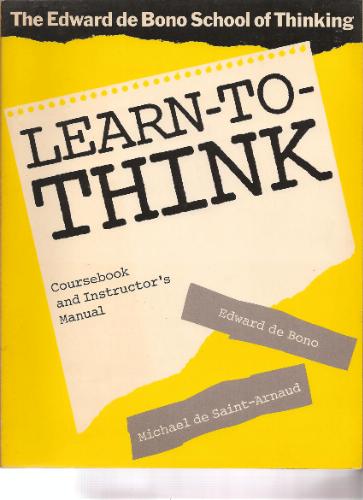
The book launched the Learn-To-Think Project in the US with the published mission: to train 300,000 Thinking Instructors to teach thinking skills in the USA.

In 1982, Michael and Edward co-authored this book which became a cover story on all global editions of Readers Digest (at that time, 1983, the world’s highest-circulation magazine with 68 million readers) and SOT launched the biggest thought-leadership program in the world for the teaching of teachers-of-thinking.
The innovative Learn-To-Think educational project received wide media attention in The New York Times, The Wall Street Journal, The Los Angeles Times, USAir Magazine and many print, radio and TV media banners across the USA and around the world.
Today, after four decades, there are over over 9 million teachers of thinking skills around the world, mostly in education and in business.
Thinking Lessons
Since metrics are important, too, we can ask these two questions:
Q. In 2024, how many thinking lessons given worldwide by thinking instructors, is the legacy of the School of Thinking?
A. When a class of 10 students attends a thinking lesson given by a thinking instructor, coach or teacher then that is ten lessons given. If a thinking instructor gives the class two lessons a week then that is around 1000+ thinking lessons a year, per thinking instructor. Multiply that by 9+ million thinking instructors in 2024 for a total of around 9 billion thinking lessons that year. Due to lessons given on other media, this may be a low number.
Q. What is the Value of a Thinking Lesson?
A. Because of neuroplasticity, the human brain is changed by circumstances. The brain before a thinking lesson is not the same brain after the lesson. Multiply this by a course of ten thinking lessons and the brain has been changed by the real change in circumstances. This applies to all the different changes in environment that a brain ever encounters.
We have a great deal of evidence showing how student’s brains have been changed by SOT lessons over the years and around the world. We get a lot of feedback and comments attesting to this.
When we ask students to dollarise the value of their thinking lessons (eg $1, $10, $100 etc) we have received feedback from “tens of thousands” to zero. But, most say between $10 and $100. If we take the low number we can value 9 billion lessons @ $10 to equal $90 billion+.
Such is the legacy of the School of Thinking in 2024.

The School of Thinking is Launched in Australia (click)
————————
• Research on School of Thinking’s methods
- Natural and Social Sciences E-book Based on Inquiry Learning to Improve Higher Order Thinking Skills of Fourth Grade Elementary School StudentsNNAS Kandi, IMC Wibawa – Thinking Skills and Creativity Journal, 2024
- Assessing ChatGPT’s Influence on Critical Thinking in Sustainability Oriented ActivitiesC Alarcón-López, P Krütli, D Gillet – 2024 IEEE Global Engineering Education …, 2024
- Can simple ideation techniques influence idea generation: comparing results from Australia, Czech Republic, Finland and Russian Federation. Belski, I., Belski, A., Berdonosov, V., Busov, B., Bartlova, M. Malashevskaya, E., …Tervonen, N. In A. Oo, A. Patel, T.Hilditch, & S. Chandran (Ed.s), Proceedings of the 26th Annual Conference of the Australasian Association for Engineering Education (pp. 474-873). Geelong, Australia: School of Engineering, Deakin University. 2015
- Engineering Creativity: The Influence of General Knowledge and Thinking Heuristics Belski, I., Skiadopoulos, A., Aranda-Mena, G., Cascini, G., Russo, D. Advances in Systematic Creativity pp 245-263 2019
- ‘E’ posibile migliorare la creattivita’ e’ la riflessivita’ dei ragazzi’ (Can we improve thinking and creativity in school children?) Tidona, G. DIALOGO – mensile regionale di cultura, politica e attualita’, n. 7, anno XXVI, October 2001
- Reflexivity and creativity at school, Tidona, G. 2002
- “The effects of the six thinking hats and speed on creativity in brainstorming”. Göçmen, O., Coşkun H., 2019
- The effects of the CoRT 1 thinking skills program on students. Edwards, J., & Baldauf, R. B. (Jr.). The effects of the CoRT 1 thinking skills programme on students. In D. N. Perkins, J. Lochhead, & J. Bishop (Eds.),Thinking: The second international conference (pp. 453–473). Hillsdale, NJ: Lawrence Erlbaum. 1987
- Measuring the effects of the direct teaching of thinking skills. Edwards, J. Human Intelligence Newsletter , 9 (30), pp.9-10;1988
- The direct teaching of thinking skills Edwards, J. G. Evans, Learning and Teaching Cognitive Skills , Melbourne, Australian Council for Educational Research, 1991, pp. 87-106; 1991
- Research work on the CoRT method. Edwards, J. In S. Maclure & P. Davies (Eds.), Learning to think: Thinking to learn (pp. 19–30). Oxford, UK: Pergamon. 1991
- The Teaching of Thinking Edwards, J. Paper presented at the Joint AARE/NZARE Conference, Geelong. 1992
- Thinking, education and human potential: International Interdisciplinary Perspectives. Melbourne: Hawker Brownlow, 6-15. 1994
- Thinking and change. Edwards, J. In S. Dingli (Ed.), Creative thinking: A multi-faceted approach (pp. 16–29). Msida: Malta University Press. 1994
- Teaching thinking in schools: An overview. Edwards, J. Teaching thinking in schools, Unicorn, 21(1), 27-36. 1995
- The direct teaching of thinking in education and in business. Edwards, J. In S. Dingli (Ed.), Creative thinking: New perspectives (pp. 82–95). Msida: Malta University Press. 1996
- Learning, Thinking and Assessment Edwards, J. Personal paper summarising work 1999
- Frameworks for Thinking A Handbook for Teaching and Learning Moseley, D; Baumfield, V.; Elliott, J.; Higgins, S.; Miller, J.; Newton, D. (2006) Cambridge University Press. ISBN 978-0-511-48991-4. OCLC 1229217614
- ^ “Thinking hats on, please: In the first of three essays this week on”. The Independent. 2 May 1994.
__________________
• Research on Thinking Instructors’ methods
• Implementation of the Science Learning Model on Critical Thinking Abilities of Middle School Students: A Review
M Hanafi, A Doyan – International Journal of Science Education and …, 2024
• Effectiveness of E-Module to Improve Students’ Critical Thinking Skills in High School Science Learning: Literature Study
A Diniyatushoaliha – International Journal of Science Education and …, 2024
V Mankki – Education 3-13, 2024
S Arifin – Jurnal Review Pendidikan dan Pengajaran (JRPP), 2024
•The Role of Brain-Based Learning in Training Students’ Critical Thinking Skills
Y Rahmawati, M Madlazim, E Sudibyo – IJORER: International Journal of Recent …, 2024
• Historical method and critical thinking in secondary school students
RLC Castillo, MAC Sarango, JMS Pena, JEG García – Universidad Ciencia y …, 2024
• SEQUENCE OF STAGES OF FORMATION OF CRITICAL THINKING IN CHILDREN OF PRIMARY SCHOOL AGE.
TG Mahmudjonovna – American Journal of Science on Integration and …, 2024
• DEVELOPMENT OF CREATIVE THINKING ABILITY OF ELEMENTARY SCHOOL STUDENTS BASED ON THE” 4K” MODEL IN MOTHER TONGUE EDUCATION
JH Gaforovna – Creativity and Intellect in Higher Education …, 2024
Critical thinking in high school science education: a focus on Fake News and Climate Change.
E Dubreu – 2024
The Impact of Critical Thinking on How Learning Outcomes are Evaluated in Primary Schools
R Kadrija, ZG Shatri, E Haxhijaha, S Mulliqi – Journal of Educational and Social …, 2023
• Divergent thinking in Italian elementary school children: the key role of probabilistic reasoning style
M Giancola, M Palmiero, A Bocchi, L Piccardi, R Nori… – Cognitive Processing, 2022
• Teachers’ Perception on Critical Thinking Skills of Vocational High School Students
AA Purnamawati, M Yahya, FD Sabran – ICES 2021: Proceedings of the 3rd …, 2022
• Measuring Critical Thinking Aptitudes of High School Students in a Private School in Dubai
G RASLAN, M ALI – 2022
• Analysis of High Order Thinking Skills (HOTS) of High School Students Learned Using the Problem Based Learning (PBL)
NI Simatupang, SRI Sitohang, E St Fatimah Azzahra – ICES 2021: Proceedings of the …, 2022
• Development of Inquiry-Based Social Science Digital Book to Improve Critical Thinking of Vocational School
F Rachman, MA Sunardi – Journal of Hunan University Natural Sciences, 2022
• The Effect of a Collaborative Programming Environment in Developing Programming Concepts and Systemic Thinking Skills for Secondary School Students
FA Almadhuni, FA Alsubaie – المجلة العلمية للجمعية المصرية للکمبيوتر التعليمي, 2022
• The effectiveness of using visual blogging (video blog) in the flipped classroom on achievement and developing visual thinking skills of middle school female students
S Aljedaani, F FELEMBAN – المجلة العلمية للجمعية المصرية للکمبيوتر التعليمي, 2022
• Computational Thinking Based Mathematic Worksheets on Student’s Problem Solving Ability With Linear Equation Two Variables at Ambarawa 1 Junior High School
M Afif – Annual International COnference on Islamic Education …, 2022
• The Impact of Project-Based Learning (PjBL) Model on Secondary Students’ Creative Thinking Skills
M de Oliveira Biazus, S Mahtari – International Journal of Essential Competencies in …, 2022
• FORMATION OF NON-STANDARD THINKING IN THE LESSONS OF MATHEMATICS IN JUNIOR SCHOOLCHILDREN
FJ Ibrokhimovich – American Journal of Pedagogical and Educational …, 2022
__________________